
After an amazing and enlightening 2 week Fund for Teachers fellowship in Myanmar with GEEO, I have been back home for a couple of weeks, but continuously reflecting on my experience. One of my goals I established in my grant proposal was to identify the role of literacy in children’s education. To accomplish this goal, I needed to learn what education is like in Myanmar. Here are some of my reflections on what I learned about Burmese education, including how literacy and language play a role.
My tour leader provided some background about the history of education in Myanmar. I learned that the Burmese language came about in the 11th century, and until the 19th century children received their education by attending the monastery. Among the subjects they learned were math, religion, and language. With the missionaries came the English language and boarding schools next to the missions. Public schools were later built, and before 2011 people even had to pay to attend public schools. Kindergarten cost $200 USD. There was a lot of corruption prior to 2011–for example, students whose families made a bigger donation would receive better grades. However, this has changed since 2011 and children no longer have to pay to attend public school. Even now, though, private schools remain more popular with those families who can afford it because they have better teachers. In public schools, students study math, Burmese, English, and physics. Many children still attend monasteries for their education. Buddhist children all attend the monastery at the age of nine. Some remain there for only a short time (somewhat like attending a church camp) whereas others stay for years, either for religious reasons or to attain an eduction.
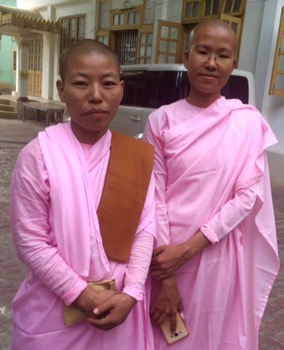
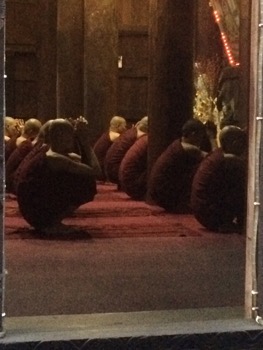
Students all worship when they first arrive to school. While 85% of the country is Buddhist, students are permitted to pray according to their own beliefs if they practice a different religion. Teachers are highly respected and honored on the level of the Buddha. Students will remove their shoes when entering a classroom just as they would at a temple, but teachers will leave their shoes on.

Literacy education starts in kindergarten with students learning to read in both English and Burmese. My tour leader told us that students often are stronger at reading and writing in English than listening and speaking. This was confirmed in some discussions I had with some young adults I met throughout my fellowship. Many university students will approach tourists and ask to practice their English. The ones that I spoke with actually seemed to have pretty decent English skills. However, they did not attribute this to their university studies. They said they had picked up most of their English from watching TV shows (one young man said that he liked “The Vampire Diaries” because the dialogue is slow so he finds it easier to pick out the words) or talking with tourists.
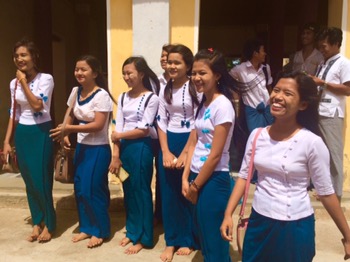
A young waiter who sounded as though he could be from the US said that his English instruction in school was very poor because the teacher was not a native English speaker and did not have strong English skills himself. We saw an example of this problem at a visit to a private boarding school. We spoke with the principal of the school and learned that he had been an English teacher. While he was very kind, he spoke in broken English and misused some words and phrases in a way that hindered communication. Not a problem for most subjects, but we would expect a teacher of English to have solid control over the language. After having a look at the text books the students use, I came to a better understanding of why students feel stronger reading and writing in English than they do speaking the language. Here is a look inside their English textbook:

The students must read large passages of English and it appears they do a lot of annotating in Burmese. It actually reminds me a lot of my college Spanish classes–we did a lot of reading Golden Age Spanish literature and we wrote a lot of papers in Spanish, but I did not have a lot of coursework that required me to actually apply my Spanish in a real-life situation. As a result, although I ended up with a double major in education and Spanish, I don’t feel confident at all in my speaking abilities. So really their foreign language instruction may not be that different from what students often face in the US when learning a foreign language.

We did visit a public primary school in a small village and while the school building was very simple and basic, I did enjoy seeing some of the educational posters that were colorful and definitely age-appropriate. I also did notice some instructional techniques we would use with our students at that age level, especially singing. One class was singing several songs in Burmese, including what appeared to be a Burmese translation of the Hokey Pokey.

On the other hand, there were some aspects of the teaching that were very different from what we find in the US. One major difference was that teachers can still use cane sticks for discipline purposes, whereas paddling students in US has fallen out of favor in most states. I also observed a lot more “teacher talk” than what we recommend in primary classrooms–in other words, the teacher was doing most of the talking, and the students would respond chorally. I did not observe a lot of student-to-student interaction. I did appreciate the small class sizes at school, although that was partly due to wide-spread illness among the children creating a lot of absences, and probably partly due to the size of the size of the village.

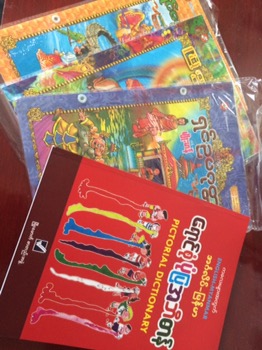
Children’s parents tell them bedtime stories growing up. Most of the stories are related to Buddha, the nats (spirits), or former kings. I will go into more detail about these stories at another time. I did notice it was kind of difficult to come across children’s literature in Myanmar. We did happen to find some books in Yangon, but the English translations in the books were not very good. Most of the children’s books we found contained stories about Buddha. In doing some research after my fellowship ended, I did find there are some organizations working to solve the problem of children’s access to books. Check out what this organization is doing! I wish I had found this before my journey!
So what can I take away from my experience that will help the families in my school?
- It is important to remember that before 2011, access to education was more difficult to come by. Since most of the families at our school left Myanmar prior to the government changes in 2011, the parents of the students may not have received much education (depending on their background).
- Children’s books are not common in Myanmar. Therefore our families may not understand the urgency of having books available at home for kids to read. Providing take-home books for the children could help, as could checking out books from the school library. But ultimately if those books are going to do any good at home, teachers need to make sure students see reading as something fun and exciting to do.
- If parents attended school, it is likely they will feel more comfortable with written English than with spoken English. At parent-teacher conferences or school information nights, it would be helpful to have a written summary of what is discussed for parents to review later.
- Students and their families will likely demonstrate a lot of respect towards teachers.
- If we receive a student that did attend school in Myanmar, it is important to remember that they are used to very different instructional delivery as well as discipline practices. Students may need time to feel comfortable with peer discussion and other activities that are common the the US classroom. Students may also need their teachers to be direct about instructions and expectations.
 Tracy Travels & Teaches
This is a great summary of what we learned on our trip, plus some extra! Thanks for sharing!
Thank you! I have been planning to write something for a couple of weeks but I really wanted to have time to reflect and process the experience so I could do it justice. Glad to have shared this experience with you!
I feel the same.